Annie Dillard: Perspective on World Catastrophe
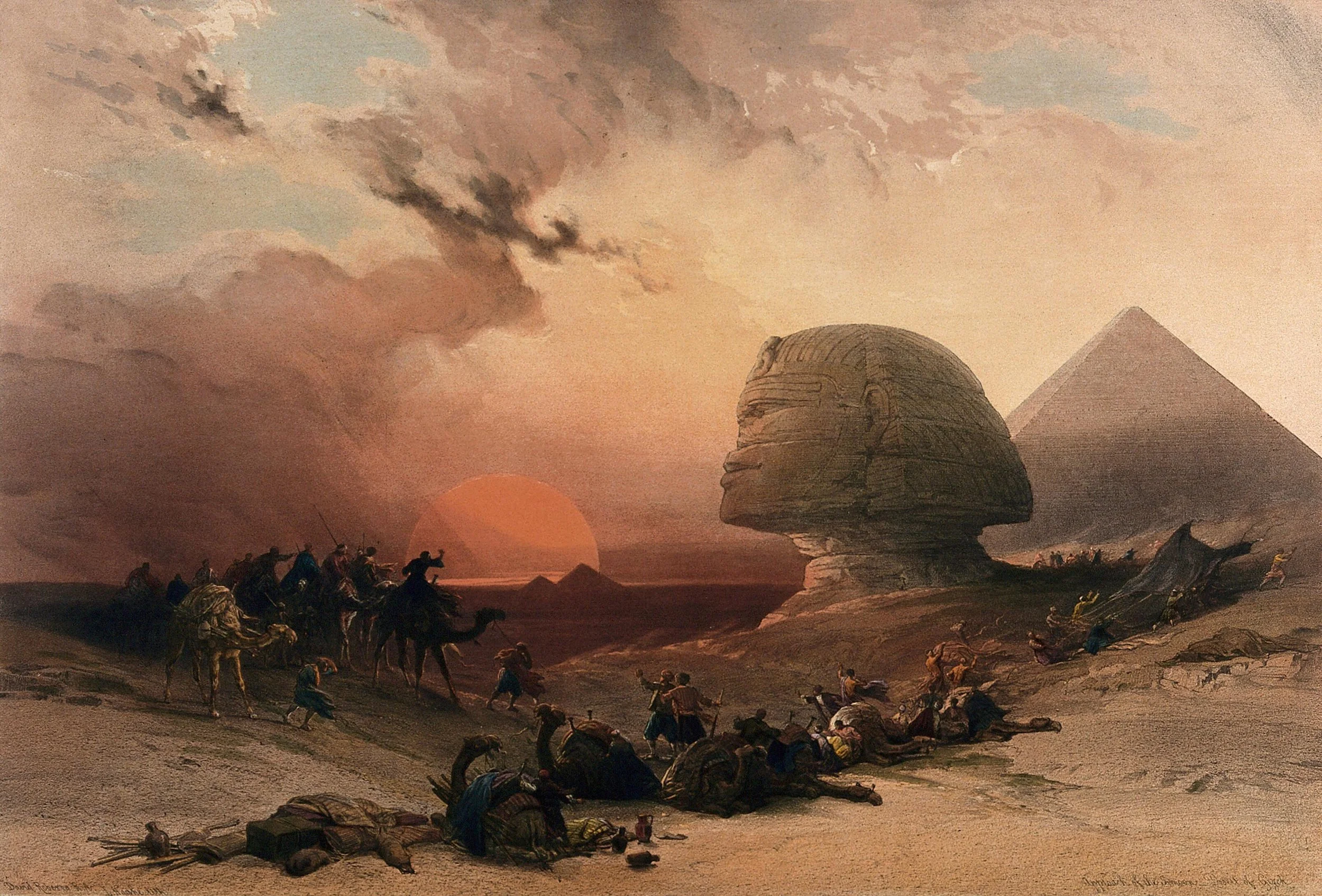
“Sandstorm approaching the sphinx at Gîza at sunset, Egypt,” colored lithograph, Louis Haghe after David Roberts, 1849.
The last thing one wants to do is defend the indefensible, especially when it is a full-scale invasion happening in the public eye. World War II has primed Americans to fear we will all look back and find ourselves Chamberlains at the decisive hour. This is probably the least helpful time to cite John Stuart Mill, who said, “Bad men need nothing more to compass their ends, than that good men should look on and do nothing.” (This saying evolved into a more famous quotation attributed to Edmund Burke.) And this fear is legitimate perhaps. However, Annie Dillard offers some perspective in For the Time Being:
“Is it not late? A late time to be living? Are not our generations the crucial ones? For we have changed the world. Are not our heightened times the important ones? For we have nuclear bombs. Are we not especially significant because our century is? - our century and its unique Holocaust, its refugee populations, its serial totalitarian exterminations; our century and its antibiotics, silicon chips, men on the moon, and spliced genes? No, we are not and it is not. These times of ours are ordinary times, a slice of life like any other. Who can bear to hear this, or who will consider it? ...
Take away the bomb threat and what are we? Ordinary beads on a never-ending string. Our time is a routine twist of an improbable yarn ... There must be something heroic about our time, something that lifts it above all those other times. Plague? Funny weather? Dire things are happening ...
Why are we watching the news, reading the news, keeping up with the news? Only to enforce our fancy — probably a necessary lie — that these are crucial times, and we are in on them. Newly revealed, and we are in the know: crazy people, bunches of them. New diseases, shifts in power, floods! Can the news from dynastic Egypt have been any different?”