Different Strokes
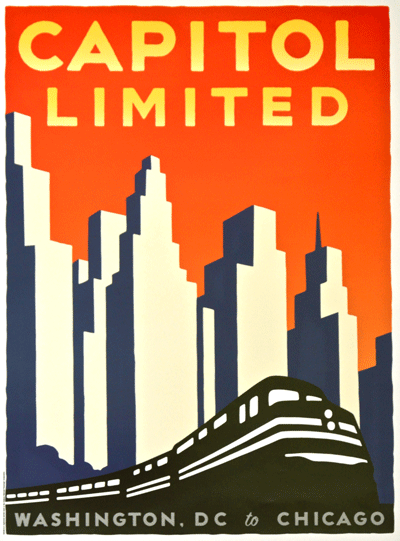
Michael Schwab’s posters — Amtrak’s redeeming quality. (copyright)
“Long ago, before the war … he used to revel in his freedom to make his own live, devise his own story … Now he understood how conceited a delusion this was. Rootless, therefore futile. He wanted a father, and for the same reason, he wanted to be a father. It was common enough, to see so much death and want a child. Common, therefore human, and he wanted it all the more.”
—Atonement, by Ian McEwan
By chance, the last two books I’ve read end as the protagonists begin to suffer a series of strokes. In both cases, the strokes upend the protagonists’ apparent ascent, revealing the weakness that’s been theirs all along. Father Urban’s (J.F. Powers’ absurd Morte d’Urban) attacks begin after a golf ball strikes his head and Briony Tallis (Ian McEwan’s Atonement) does not know of her strokes until a medical exam finds them.
Each story follows the protagonist’s ascent and delusional aspirations for prestige. The strokes coincide roughly with Urban and Briony’s fully confronting their deception for the first time. Father Urban’s accident happens at the rural retreat center that he turns into a thriving golf course out of bored ambition. Briony as a teenager lied about a sexual assault she witnessed, thus sending the wrong man to prison. She writes about it years later, only beginning to atone for the life of hurt she’s caused.
I recall the Jesuit priest at college who called 911 while having a stroke and was back to coaching boxing a month later. It Italian a stroke is called an ictus — a grammatical marking (‘), the similarly shaped early Christian fish (Greek, ichthus “fish”), a marking later adapted for timing breaths in the Solesmes method of Gregorian chant. A stroke, on the chart of a heartbeat, is literally that — a small pointed space where the blood (oxygen?) has temporarily stopped reaching the brain.
Briony takes her strokes better than Urban, but hers are milder. J.F. Powers’ novel returns throughout to the steady, willful trains the the Midwest powerful populate. They spend their conversations comparing train lines to one another, complaining about them, conferring status by their preferred lines. Urban is part of it and is undone by them, in a way. At the end, Powers describes the ischemic attacks this way:
___
By the way, these are both excellent books. (Major content warning on the first third of Atonement.)