Garden II: New Adam and New Eve
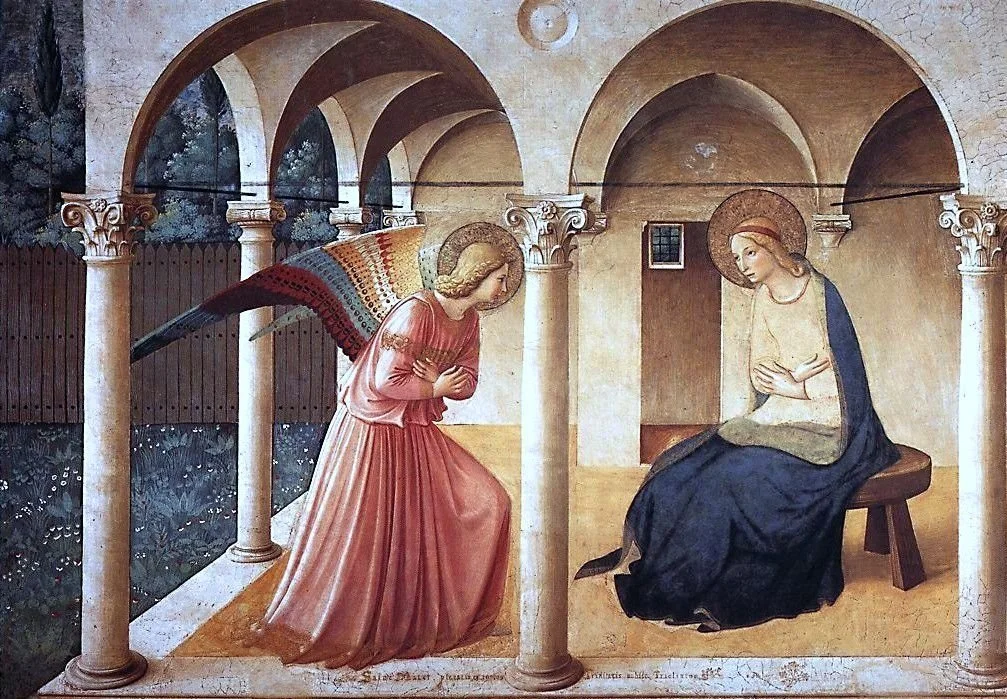
Fra Angelico, Annunciation (1437-46), Convent of San Marco, Florence. (source: Taken on 2 February 2008, CC BY 2.0, https://commons.wikimedia.org/w/index.php?curid=5446878)
The New Adam
5. “But in fact Christ has been raised from the dead, the first fruits of those who have died. For since death came through a human being, the resurrection of the dead has also come through a human being; for as all die in Adam, so all will be made alive in Christ. But each in his own order: Christ the first fruits, then at his coming those who belong to Christ.” (1 Cor. 15:20-23, emphasis added)
6. Origen calls Jesus Christ the autobasileia, the “kingdom in himself.” Jesus is the Garden, as he is the Temple: He is the place of ordered, right relationship with God. His Passion is the place where the passions are made into perfect love.
7. “By his obedience unto death, Christ communicated to his disciples the gift of royal freedom, so that they might ‘by the self-abnegation of a holy life, overcome the reign of sin in themselves’: That man is rightly called a king who makes his own body an obedient subject and, by governing himself with suitable rigor, refuses to let his passions breed rebellion in his soul, for he exercises a kind of royal power over himself.” (CCC, para. 909)
8. “Like a priest with fragrant incense, Adam’s keeping of the commandment was to be his censer.” (St Ephrem the Syrian)
9. “[Adam’s obedience] was to be an act of praise, a liturgy of worship. … To obey is to live in a state of sonship. It is to confess with the full force of my freedom that I have an infinitely good Father who loves me with infinite love. By obeying him I realize the extent of my freedom and find that it grows ever more immense. On the burning coals of free self-giving, even humdrum duties release a fragrance of adoration, becoming priestly acts of grandeur, sweet incense burnt in the censer of obedience. As long as we keep swinging it, our entire life becomes a liturgy of praise, an oblation of love. That is the bottom line of religious obedience.” (Erik Varden, OSCO, Entering the Twofold Mystery: On Christian Conversion, pp. 22-23)
10. “‘If it is your desire to offer your heart to Christ as a garden of delights, do not take it ill if you are enclosed by this rampart [the Rule] … One who does not know how to be enclosed, does not know how to be a garden.’ Such a one remains uncultivated wilderness, ‘a solitude,’ in the language of the Old Testament. For enclosure … means encounter. It is love itself.” (Erik Varden, OSCO, Entering the Twofold Mystery, pp. 44-45, commenting on a quotation by Abbot Gilbert of Hoyland)
The New Eve
11. Mary is the foretaste of healed humanity.
12. Mary the Garden: the tradition identifies Mary with the hortus conclosus (enclosed garden) of Song of Songs 4:12. She is the place of healed passion and, in her preservation from sin, the promise of fruitfulness. Medieval art (e.g., Fra Angelico’s Annunciation) often shows Mary in an enclosed garden. This tradition contributed to the presence of central gardens in cloistered communities. Pointedly, one version of Fra Angelico’s Annunciation simply replaces the enclosed garden with an image of Adam and Eve’s banishment.
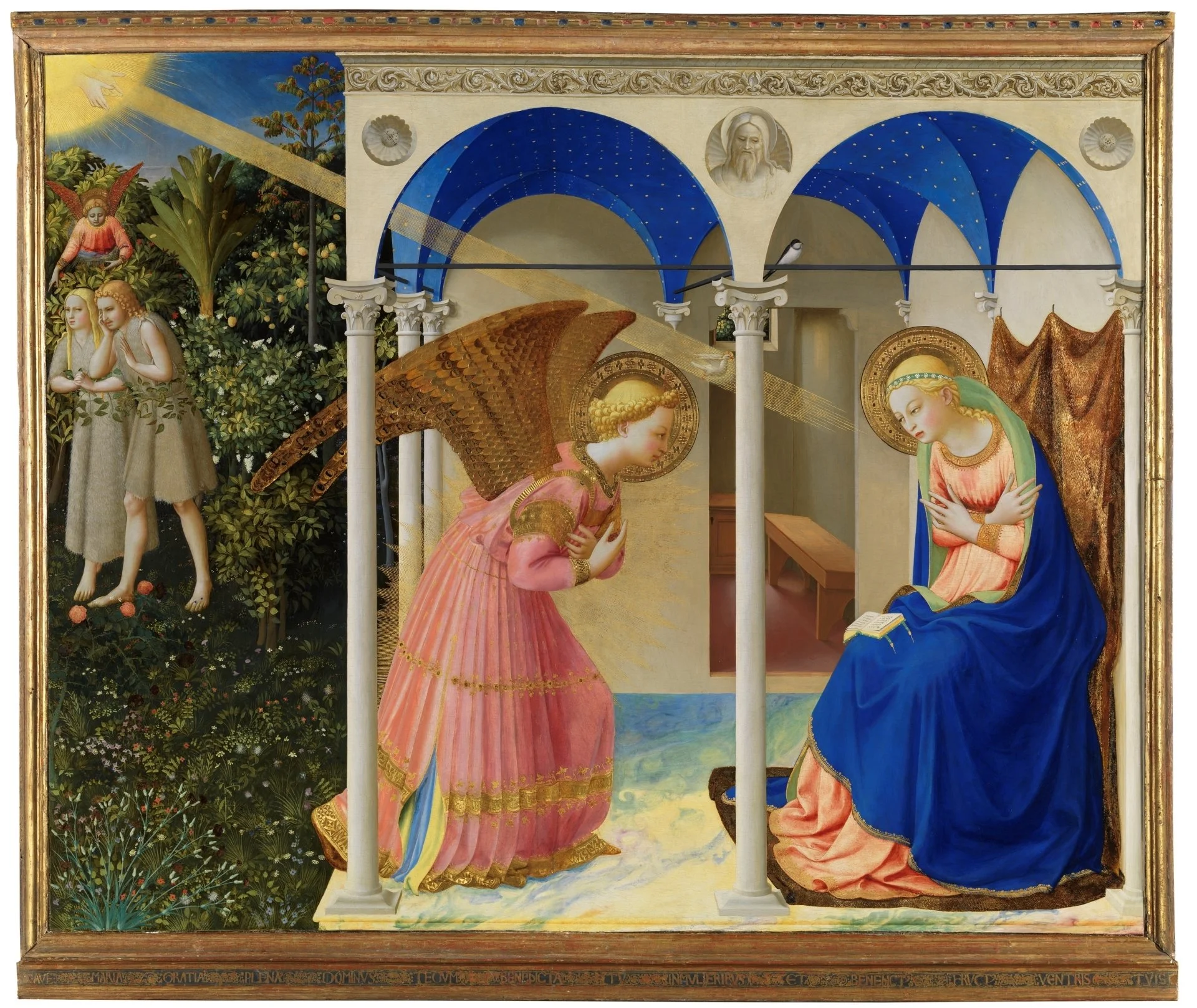
Fra Angelico, The Annunciation, altarpiece for Santo Domenico in Fiesole, ca. 1426. Tempera on panel. (used with permission: https://www.museodelprado.es/en/the-collection/art-work/the-annunciation/f8e45a6f-7645-4e53-9fd5-cbdae7e8faac)
13. “By his virginal conception, Jesus, the New Adam, ushers in the new birth of children adopted in the Holy Spirit through faith. ‘How can this be?’ Participation in the divine life arises ‘not of blood nor of the will of the flesh nor of the will of man, but of God.’ The acceptance of this life is virginal because it is entirely the Spirit's gift to man. the spousal character of the human vocation in relation to God is fulfilled perfectly in Mary's virginal motherhood.” (CCC, para. 505)