Good Friday Morning
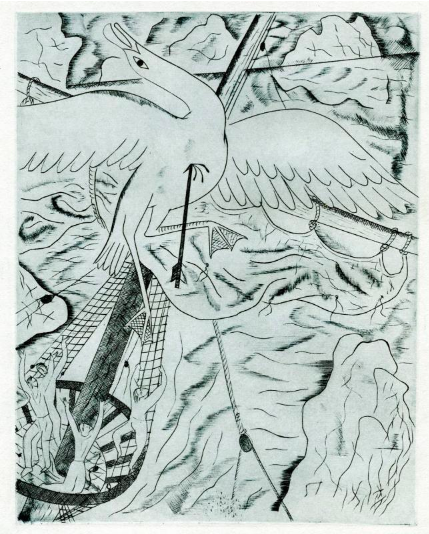
David Jones (Anglo-Welsh, 1895-1974) “The Albatross,” 1928 from the suite “The Rime of the Ancient Mariner.” (source: https://www.goldmarkart.com/art-for-sale/the-wedding-guests-14224)
At the cry of the first bird
They began to crucify Thee, O Swan!
Never shall lament cease because of that.
It was like the parting of day from night.
Ah, sore was the suffering borne
By the body of Mary's Son,
But sorer still to Him was the grief
Which for His sake
Came upon His Mother.
(anonymous, 12th century Gaelic, trans. Howard Mumford Jones)
Reading this morning from the beginning of Edith Stein’s final book, The Science of the Cross (Kreuzeswissenschaft), on the topic of St. John of the Cross. Did not realize that Juan de la Cruz was fairly unknown in German-speaking communities before Stein’s work. Introducing the book, Stein reflects on St. Juan’s artistic qualities. A portion is below.
First though, an eminently worthwhile book on the topic of art is The Song That I Am: On the Mystery of Music, by Élisabeth-Paule Labat. Labat was a pianist and composer in the early 20th century who studied at the Parisian Schola Cantorum, where exposure to Gregorian chant sparked a deepening of her faith. She entered a Benedictine abbey in 1922. Recently translated by Erik Varden, OSCO, the work is the best summary I’ve seen on the nature of music, the phenomena of artistic life, and music’s relation to the transcendent.
Stein’s reflections on the vocation of the artists, and the pitfalls thereof:
“There is a danger in an artistic inclination, and not only when the artist lacks an understanding of the sacredness of his task. The danger lies in the possibility that in constructing the image, the artist proceeds as though there were no further responsibility than producing it. What is meant here can be demonstrated most clearly by the example of images of the cross. There will scarcely be a believing artist who has not felt compelled to portray Christ on the cross or carrying the cross.
But the Crucified One demands from the artist more than a mere portrayal of the image. He demands that the artist, just as every other person, follow him: that he both make himself and allow himself to be made into an image of the one who carries the cross and is crucified.
Expressing the image externally can be a hindrance to doing so internally, but by no means must this be so; actually, it can serve the process of interior transformation because only with the production of the external expression will the inner image be fully formed and interiorly adopted. In this manner, when no obstacle is placed in its path, it becomes an interior representation that urges the artist to effectively reproduce it in action, that is, by way of imitation, externally.
And yes, the external image, one’s own artistic creation can always serve to spur one on to transform oneself interiorly according to its meaning. We have every reason to suppose that this applies to John: childlike, artistic and holy realism were combined in him and supplied for the message of the cross the most favorable soil in which it could grow into the science of the cross.”
(Edith Stein, The Science of the Cross, “Introduction: Meaning of the Science of the Cross and the Essentials of Its Origin,” trans. Josephine Koeppel, OCD, ICS Publications)